Whittling at Ambleford: more than the finished object
At Ambleford, whittling is a firm favourite. Children arrive brimming with ideas: knives, spears, bows and arrows, walking sticks, tent pegs, little figures, bits of “useful” woodland kit. We support all of that creativity, but what consistently surprises parents is this: more often than not, it isn’t the finished object that matters most to the children.
It’s the act of whittling itself.
The slow shaving of wood.
The sound of the blade.
The focus.
The quiet.
There is something deeply satisfying about sitting with a stick and a knife and simply working. Many children will happily whittle the same piece of wood for an hour, even when the end result barely changes. What they are really enjoying is the process — the calm, the rhythm, the sense of control and competence.
I’ve taught hundreds of children to use knives safely over the years, and I can say with confidence that whittling consistently brings children into a mindful, almost meditative state. In a world of instant rewards, flashing screens and constant stimulation, whittling asks something very different of them.
And that difference matters.
The quiet benefits of whittling
Whittling offers children something increasingly rare:
- Deep focus without pressure – there is no timer, no level to complete, no external reward.
- Delayed gratification – progress is slow and earned, not instant.
- Embodied learning – hands, eyes and brain working together.
- Confidence through trust – being trusted with a real tool changes how a child sees themselves.
- A genuine break from screens – not enforced, but chosen.
Children who struggle to sit still will often sit for long periods while whittling. Children who find group settings overwhelming often find calm in the repetitive, predictable movement of the knife through wood. It is regulating in a way very few activities are.
And importantly: whittling is not something that has to live only in woodland settings.
It is absolutely something you can do with your child at home.
Tool choice: simple, affordable and purposeful
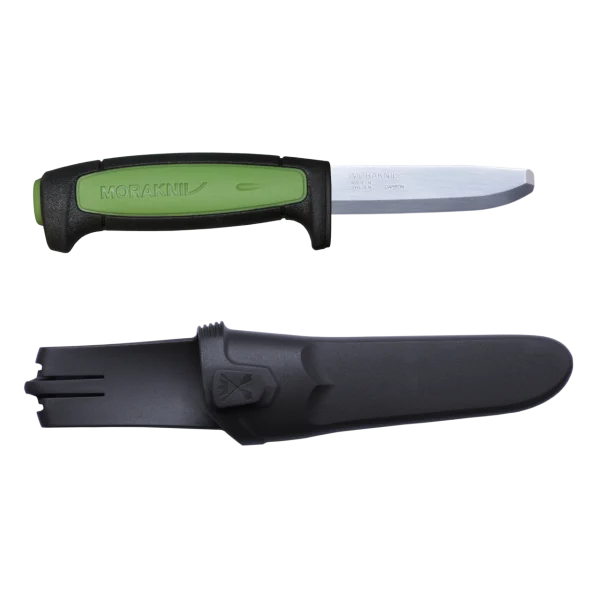
At Ambleford, our knife setup is deliberately simple.
We use:
- A non-pointed, fixed blade knife, costing around £10–£15 (as pictured)
- A small cut-resistant glove (available on Amazon)
- That’s it
We do not use folding knives with children. Fixed blades are stronger, more predictable and remove the risk of a blade closing unexpectedly. A rounded or squared tip reduces puncture risk without limiting usefulness.
The cut-resistant glove is worn on the hand holding the wood, not the knife.
The knife hand is always bare. This is important:
- A bare hand gives the best possible grip
- The knife hand should never be in danger if the technique is correct
- Gloves on the knife hand reduce feedback and control
This setup is accessible, affordable and entirely sufficient for safe whittling at home.
Choosing the right wood
In truth, almost any wood can be whittled — but not all wood feels friendly to beginners.
Children find green wood (freshly cut from a tree) much easier to work. It is softer, cuts more cleanly and is far less frustrating than dry, seasoned wood.
My top recommendation: Hazel
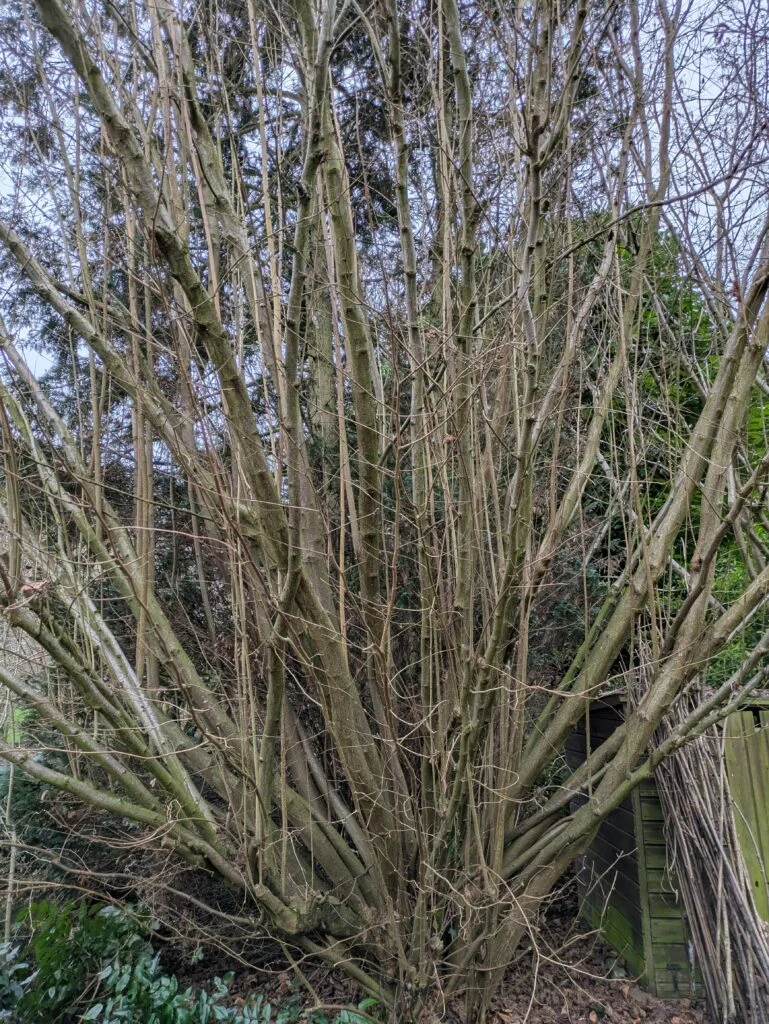
Hazel (pictured) is ideal for children because:
- It grows straight
- It is strong but not too hard
- Long sections can be found without knots
- It peels and whittles beautifully
Other good choices include:
Lime (linden) – excellent if you can find it
Willow – very soft and forgiving
Elder – easy to cut (though the pithy centre limits strength)
Birch – slightly harder, but smooth and satisfying
Avoid very hard woods (like oak) for beginners, and be cautious with woods full of knots, twists or splits, as these can cause the knife to snag or jump.
Safety: trust, structure and clear boundaries
At Ambleford, tool use is framed very clearly:
Using a knife is a privilege, not a right.
And privileges come with responsibility.
Children understand this — and they rise to it.
Below are the core safety principles we use and strongly recommend for home use.
1. Storage and permission
- The knife has a fixed storage location in your home
- It is asked for each time
- It is returned immediately after use
- It does not leave the house without express adult permission
This removes casual handling and reinforces respect for the tool.
2. Personal protective habits
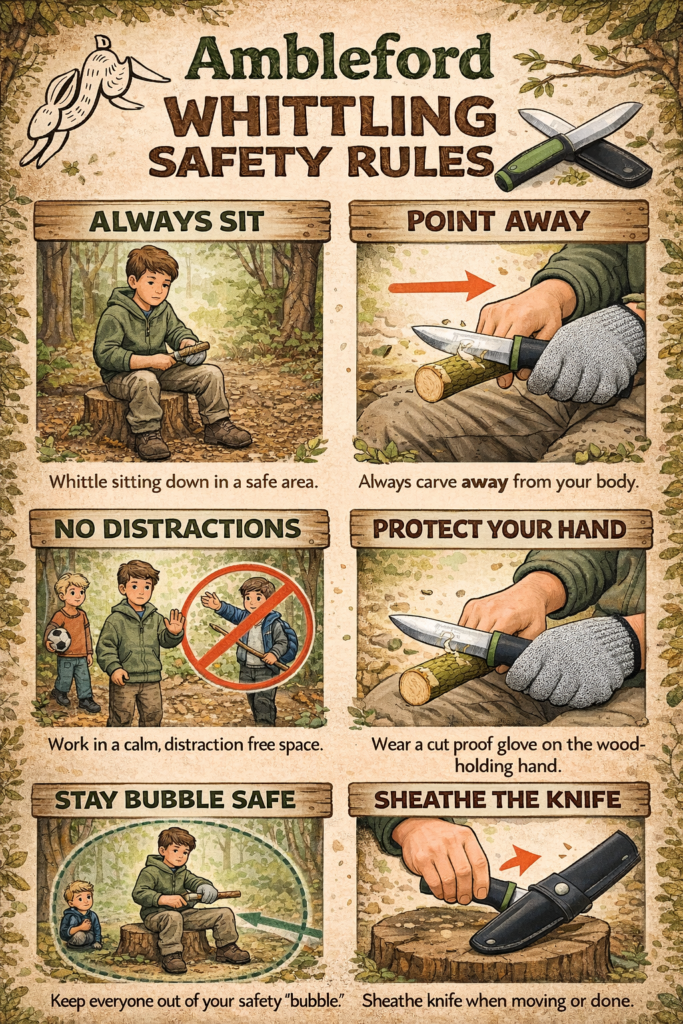
- The cut-resistant glove goes on the non-knife hand
- The knife hand is always bare
- Sleeves, scarves or loose clothing are secured
- Long hair is tied back
3. Position and focus
- Whittling is always done seated
- Feet are planted
- There are no distractions — no running children nearby, no playing while holding a knife
- Whittling is a stand-alone activity, not something done alongside games or conversation
4. Direction of cut
This is non-negotiable:
- The knife always moves away from the body
- Never towards the torso, legs or hands
- Small, controlled cuts only
- No forceful carving
Children are taught that speed and strength are not skills — control is.
5. The “bubble” rule
Every child works within their own safety bubble:
- Arm’s length plus the length of the tool
- No one enters another person’s bubble
- Children are responsible for checking their space before starting
This builds spatial awareness and responsibility for others, not just themselves.
6. Awareness of surroundings
Children are taught to:
- Choose a low-traffic area
- Be aware of who is nearby
- Pause if someone approaches
- Stop immediately if concentration drops
A distracted child does not whittle.
7. Knife management
- The knife is either in use or in its sheath
- If the child stands up, moves location or collects materials, the knife goes straight into the sheath
- A knife is never left unattended
- A knife is never passed hand to hand — it is placed down and picked up
A final thought
Children are capable of far more than we often give them credit for.
When we trust them with real tools, clear boundaries and high expectations, they do not become reckless — they become careful. Proud. Calm.
Whittling is not about teaching children to carve wood.
It is about teaching them patience, awareness, responsibility and self-trust.
And sometimes, it’s simply about sitting quietly together, shaving curls of wood from a stick, and letting the world slow down for a while.
That, in itself, is a rare and valuable thing.
Free Download: Ambleford Quick Reference Safe Whittling Poster: